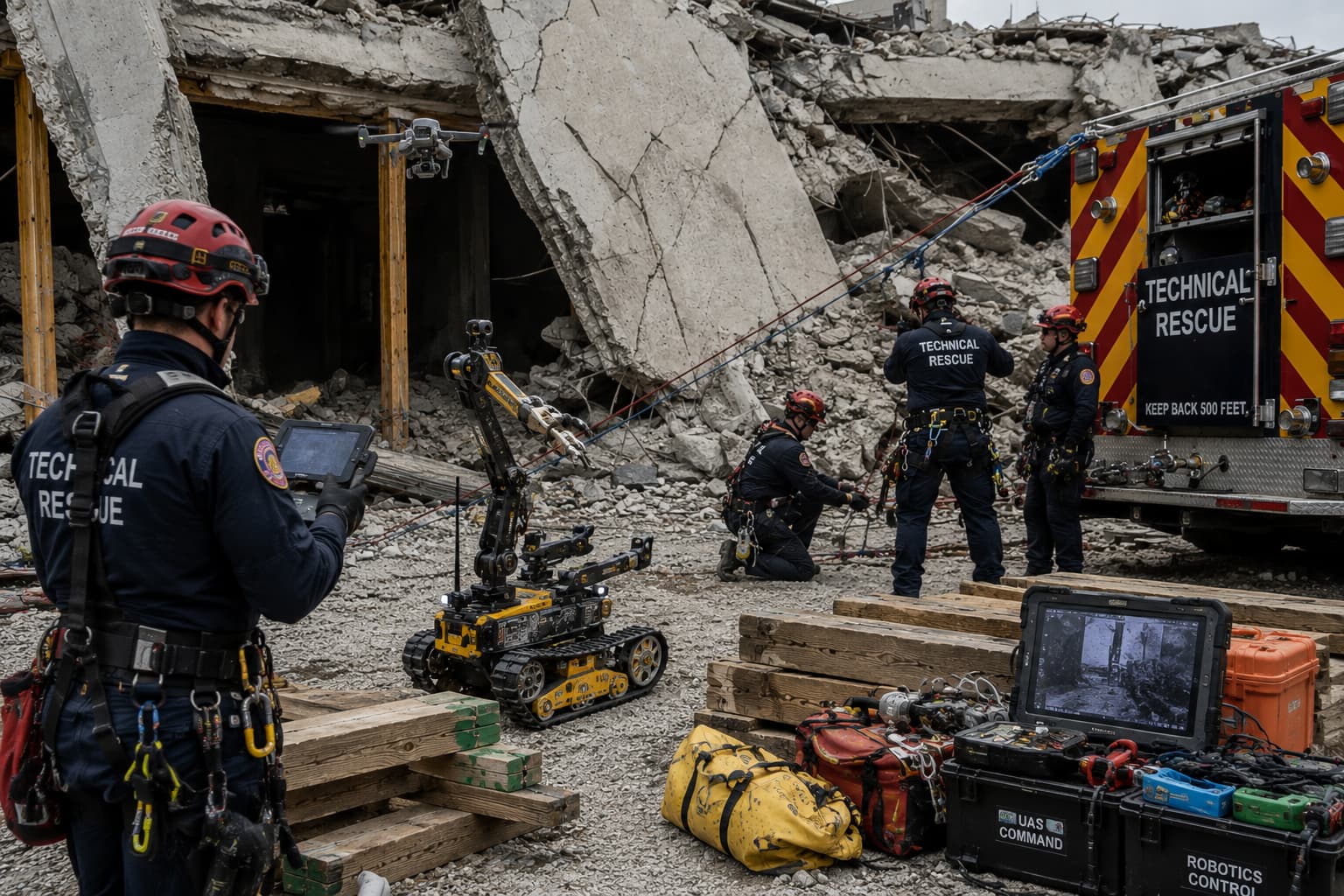
Technical rescue team rigging a rope system over a collapsed structure while a small drone surveys the void space.

UAS and robotics

Drones and response robots can give responders access to information or environments that would otherwise require placing a person in harm's way. The important question is no longer whether public safety can use unmanned systems. It is which mission they are being used for, whether the system can reliably perform that mission, who operates it, what regulatory authority applies, and what happens to the data it collects.

What good should look like

  • The mission is defined before the platform is selected.
  • Operators maintain measurable proficiency, not just a certificate.
  • The department understands which FAA operating authority it flies under.
  • Policies cover airspace, privacy, evidence, records and data retention.
  • The platform has been tested against realistic mission tasks, not a demonstration.
  • Communications range and loss-of-link behavior are understood before it matters.
  • The aircraft or robot can actually operate in the environment it is bought for.
  • A manual or alternate method remains available when the technology cannot deploy.

Still in development

Innovation Lab

Maturity: Research / Beta

Autonomous and semi-autonomous response robotics

Remote-operated response robots are already used in some public-safety missions. The emerging question is how much navigation, mapping, object recognition and task execution can safely be automated in complex, changing emergency environments.

Why it matters

Greater autonomy could reduce operator workload and allow robots to work in environments that are difficult to navigate manually. Emergency scenes are also unpredictable, communications are unreliable and errors can have serious consequences. The useful questions are what the machine does when it loses its link, how it behaves when its map no longer matches the building, and who is accountable for what it does next.

NIST response robot programs, university research, early vendor work

Maturity: Early adoption

Autonomous drone response

Docked aircraft that launch on dispatch, fly to the incident and stream without a pilot at the scene.

Why it matters

Technically working today. The constraint is regulatory — beyond visual line of sight authority — and it is loosening. Departments that understand the waiver process now will move first.

Law enforcement DFR programs, a small number of fire agencies

Recommended research

Government, standards and peer-reviewed sources on this problem. Every address here was checked before it was published.

How these sources are labeled

Hub guide
Written by the Hub.

Nothing here is paid placement. Links are chosen because they are the clearest explanation we could find, and labeled so you know who wrote them.