
Part 5 of 6
Learning, Exercises & Documentation
For program managers whose after-action reports keep finding the same thing twice: how an exercise turns a plan into preparedness, what has to happen to a finding before it counts as learned, and why recovery documentation starts while the incident is still running.
A lesson identified does not become a lesson learned until something changes.
Plans are not preparedness
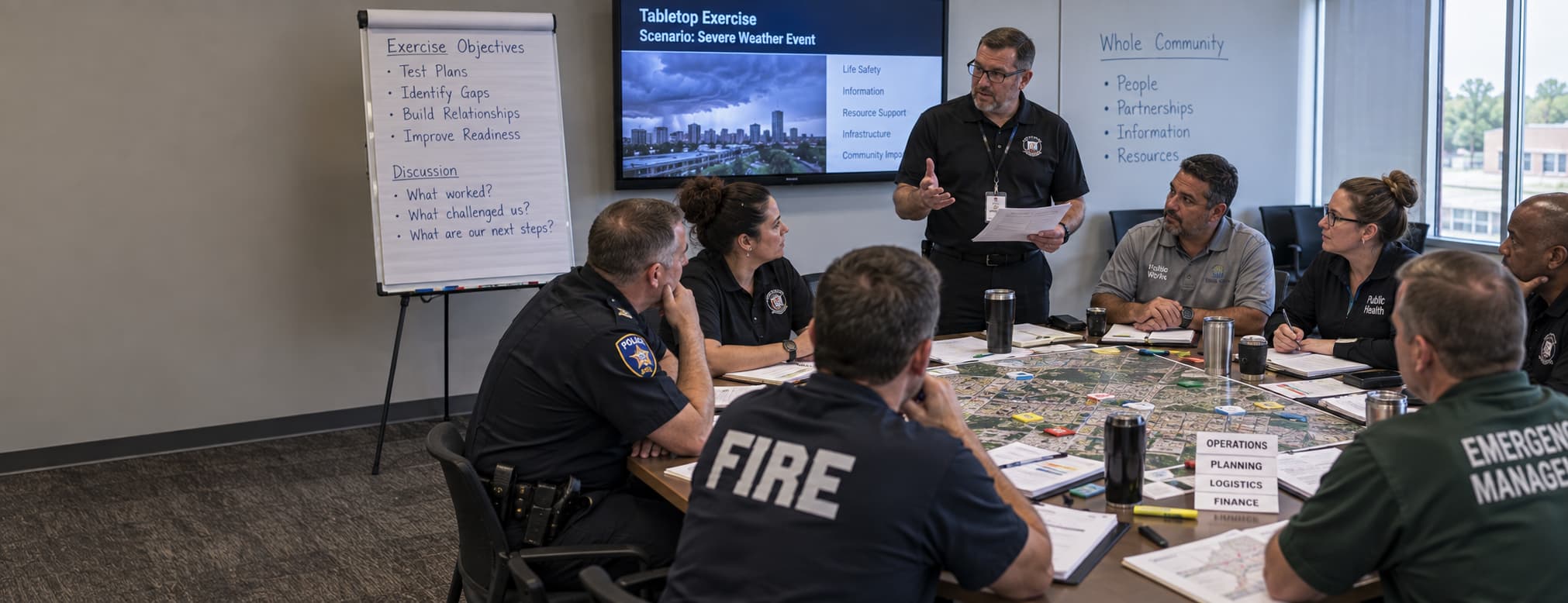
A plan is a hypothesis about how you will behave. Preparedness is what happens after you test it. The exercise program methodology most jurisdictions use is HSEEP, which exists to make that testing consistent enough to learn from.
- Plan
Write down how it is meant to work, and who does what.
- Train
Make sure the people named in it know that, and can do it.
- Exercise
Try it. Discussion-based to start — a workshop, a tabletop, a game — then operations-based: a drill, a functional exercise, a full-scale.
- Evaluate
Against the capability you were testing, not against whether the day went smoothly.
- Improve
Change something. This is the step that is skipped.
- Revise the plan
So the document matches what you have learned.
The purpose of an exercise is not to prove the plan worked. It is to find out where it does not, while that is still cheap.
After-action without action is just a report
A lesson identified does not become a lesson learned until something changes. Every step below has an owner; the ones in the middle are where reports go to die.
- Observation
Somebody noticed something, and it was written down while it was fresh.
- Analysis
What actually caused it, as opposed to what it looked like.
- Corrective action
The specific change that would stop it happening again.
- Owner
A named person. Not a department.
- Due date
A real one.
- Verification
Evidence that it was done, not an assurance that it was.
- Closed
And visible, so the next report can show whether it stayed closed.
The most valuable thing in an after-action file is a finding that appears twice.
Recovery starts during response
A major incident creates a second emergency management problem underneath the first: proving what happened, what was damaged, what was spent, why the resources were needed, and what decisions were taken.
That proof is assembled from things that can only be captured while they happen. Deciding afterwards how to collect them is deciding not to have them.
- Personnel — who worked, when, in what role
- Overtime, separately and defensibly
- Equipment use, by hour and by piece
- Supplies consumed
- Contracts, and how they were procured
- Mutual aid given and received
- Damage, assessed and located
- Debris — quantity, type, where it went
- Photographs, with locations and times
- Operational decisions, and who made them
- Resource requests and what came of them
- Mission assignments, where applicable
This page gives no reimbursement or legal guarantees, and nothing here is advice about eligibility. The principle is the part that generalizes: if documentation will matter during recovery, decide how it is collected before the disaster.
What to do next
The last part is the practical end: departments that have done this, the research behind it, and where to start when the budget is small.
Read: Resources & Getting Started