Official resourceU.S. Fire Administration
The federal starting point: what CRR is, the five E's, and short accounts of what named departments actually did under each one.
Why it matters
If you read one thing before writing a plan, read this. It is free, it is short, and it is the vocabulary everyone else in this list assumes you have.
Official resourceNFPA
The consensus standard for how a community risk assessment is conducted and how a CRR plan is developed from it.
Why it matters
This is the document a peer reviewer, an accreditation team or a sceptical council member will measure your assessment against. Read the standard before you buy anything that claims to satisfy it.
Official resourceU.S. Fire Administration
The wider USFA prevention section that the CRR material sits inside — codes, public education, data and outreach campaigns.
Why it matters
Where to go once you know which of the five E's you are working on.
Official resourceNFPA
NFPA's collection of CRR material — the definition used in NFPA 1300, tools, and its CRA data dashboards.
Why it matters
The bridge between the standard and something you can act on this month.
Official resourceNational Fire Academy
A free online self-study course on what makes up a CRR strategy and how the process works.
Why it matters
The NFA recommends taking this one before the risk assessment course. Free, self-paced, and it gives a whole department the same vocabulary.
Official resourceNational Fire Academy
A free online self-study course on conducting a risk assessment: the vocabulary, working with demographic and community data, and dealing with stakeholders.
Why it matters
The practical companion to NFPA 1300, and the cheapest way to find out whether you can write the assessment yourself.
Official resourceCenter for Public Safety Excellence
How the CRA and the standards of cover fit together in CFAI accreditation: measuring fire and non-fire risk across a service area, then stating what the department can actually deliver against it.
Why it matters
If your department is accredited or heading that way, this is the frame your risk assessment has to fit. It is also the clearest published explanation of why an assessment and a deployment plan are two halves of one argument.
Industry articleInternational Association of Fire Chiefs
The IAFC's position on CRR as an evidence-based, all-hazards strategy rather than an add-on to fire prevention.
Why it matters
Useful when the argument you have to win is internal. It is the chiefs' own association saying this is the job now.
Official resourceU.S. Fire Administration
The federal replacement for NFIRS, and the incident dataset a community risk assessment will increasingly be built on.
Why it matters
Your incident history is half of any risk assessment. What NERIS collects decides what questions you will be able to ask of it later.
Official resourceFire Safety Research Institute
The NERIS programme site, run by FSRI with the USFA: documentation, onboarding and the data model itself.
Why it matters
The place to look before a vendor tells you what NERIS requires.
ResearchInjury Prevention
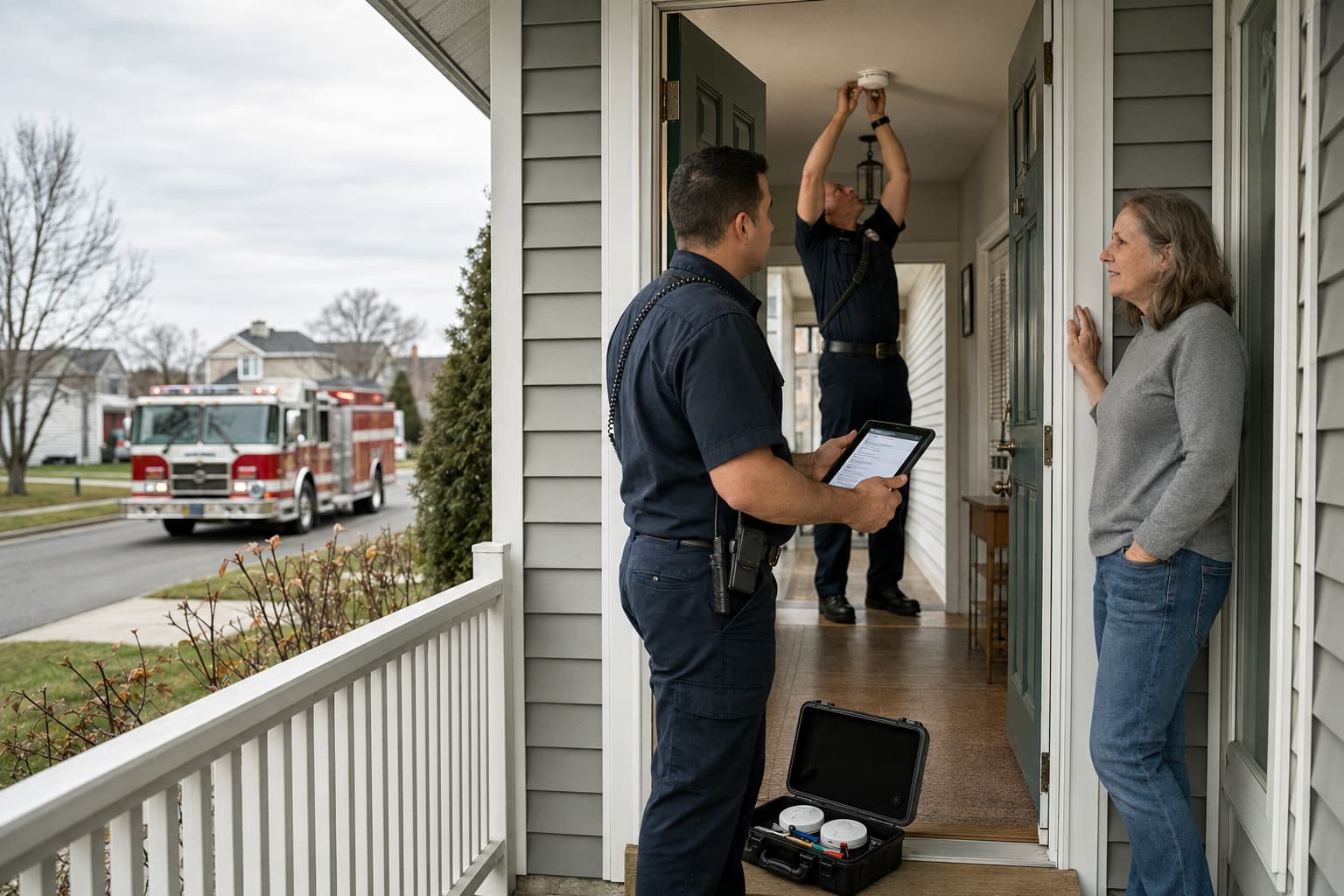
The outcome evaluation of Operation Installation in Dallas. Volunteers and firefighters canvassed 36 high-risk census tracts between 2001 and 2011; the study followed 8,134 programme houses against 24,346 non-programme houses in the same tracts.
Why it matters
Over a mean of 5.2 years, house fire deaths and injuries were 68% lower in programme houses (3.1 vs 9.6 per 100,000; rate ratio 0.32, 95% CI 0.10 to 0.84), and 63% lower after adjustment. It also found the effect fading after year six as alarms stopped working — which is the more useful half of the finding, and the half that gets left out of the slide.
ResearchInjury Prevention
What the same Dallas programme cost, and what it returned. Free to read in full.
Why it matters
Estimated net savings of $3.8 million over 2001-2011, a $3.21 return for every dollar spent from a societal perspective, and an incremental cost per fire injury averted of $128,800 counting only direct programme and medical costs. That last figure matters as much as the first: it is what the programme costs before you count lost productivity, and a council will ask.
ResearchInternational Journal of Environmental Research and Public Health
Twelve years of the HomeSafe programme in Surrey, British Columbia, across 120,349 households, comparing each initiative against both the pre-intervention period and the city-wide trend.
Why it matters
It reports which parts worked and which did not. Firefighter home visits, alarm inspection and installation, and alarm checks at incidents were the three effective initiatives; door hangers and package distribution were not. Programmes that publish their failures are rarer than they should be, and more useful.
ResearchInternational Journal of Environmental Research and Public Health
A systematic review of what has been tried, and what has been shown to work, in the neighbourhoods and communities that carry the most residential fire risk.
Why it matters
Risk is not evenly distributed, and neither is the evidence. This is the review to read before designing a programme for the part of your jurisdiction that carries most of the loss.
ResearchJournal of Community Health
A synthesis of the US fire prevention programmes that had actually been evaluated, and what the evaluations found.
Why it matters
Its conclusions are still the ones that hold: canvassing and installing beats handing out, partnerships with fire departments work, using existing data systems to target and evaluate works — and alarms not working remains the recurring problem. Older than the rest of this list, and still the clearest statement of what is known.
ResearchInjury Prevention
What the discipline of injury prevention has contributed to home fire safety, and where the gaps still are.
Why it matters
The best short argument for why CRR is a public health method applied to the fire problem, rather than fire prevention with a new name.