
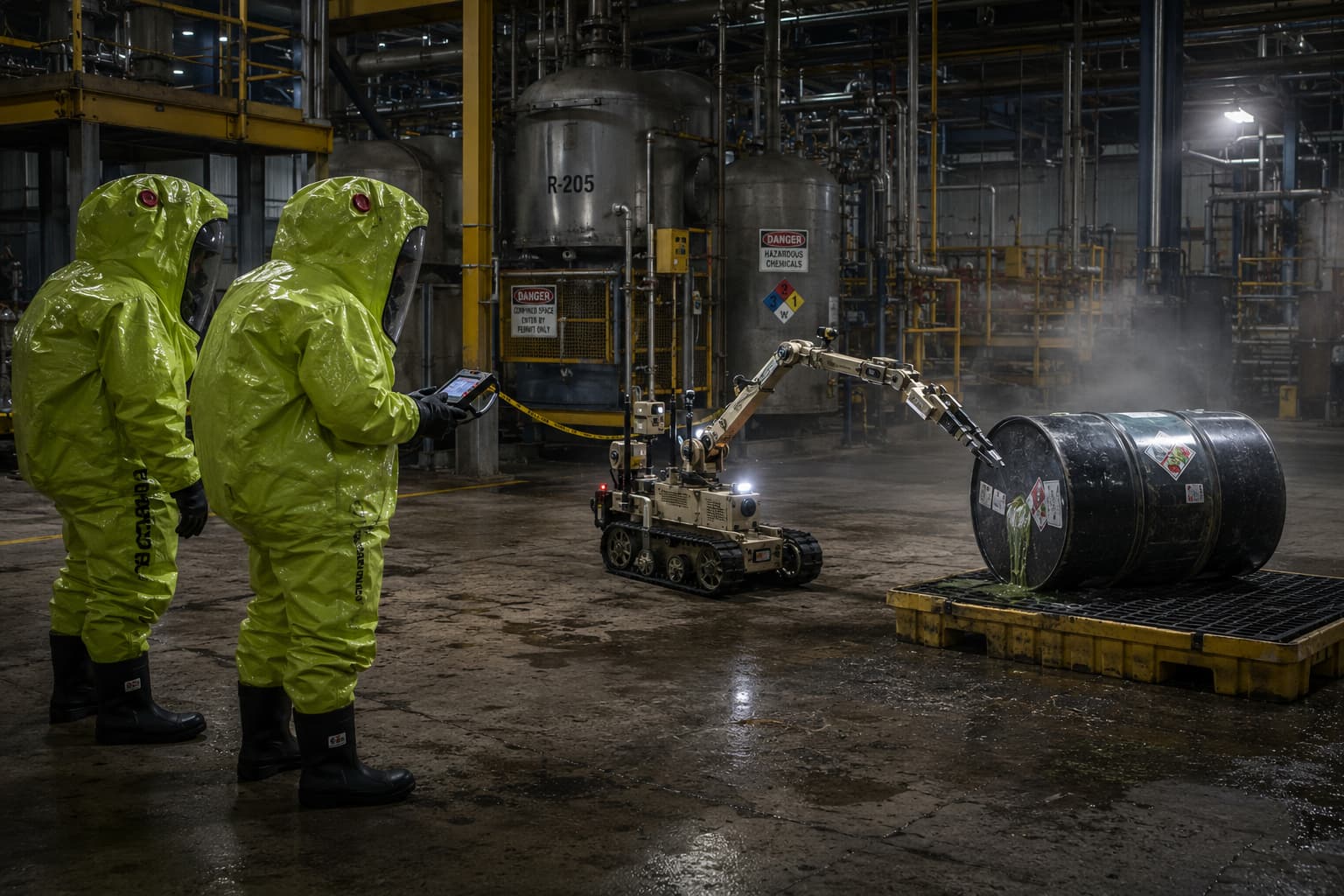
Hazmat technicians in Level A suits directing a tracked unmanned ground vehicle toward a chemical release inside an industrial facility.

Hazmat response

Hazardous-material response technology should increase the amount of useful information the team can collect while decreasing unnecessary responder exposure. Detection instruments, chemical databases, weather data, plume models, UAS and ground robots can support reconnaissance and decision-making, but none eliminates the need to understand the limitations of the instrument or model.

What good should look like

  • Technology reduces unnecessary entry into the hazard area.
  • Meter and sensor limitations are understood.
  • Remote information supplements rather than replaces confirmation.
  • Models clearly display assumptions and uncertainty.
  • Weather inputs can be updated.
  • Instrument readings can be documented and compared over time.
  • Teams maintain alternate methods when a platform or sensor fails.
  • Equipment can be decontaminated or appropriately managed following exposure.

Still in development

Innovation Lab

Maturity: Research / Beta

Autonomous and semi-autonomous response robotics

Remote-operated response robots are already used in some public-safety missions. The emerging question is how much navigation, mapping, object recognition and task execution can safely be automated in complex, changing emergency environments.

Why it matters

Greater autonomy could reduce operator workload and allow robots to work in environments that are difficult to navigate manually. Emergency scenes are also unpredictable, communications are unreliable and errors can have serious consequences. The useful questions are what the machine does when it loses its link, how it behaves when its map no longer matches the building, and who is accountable for what it does next.

NIST response robot programs, university research, early vendor work

Peer experience

Mutual Aid

Drone platform for hazmat monitoring — what are people flying?

Need something that can carry a four-gas meter and survive decon. Our current airframe is not rated for it. What sensor are you carrying, and has it been validated in that configuration rather than on a bench? How are readings transmitted, and at what stand-off distance? How does decon affect the aircraft, and is the platform treated as disposable once it is contaminated? What is your plan if communications fail while it is over the release?

Example — the forum is not open yet

Recommended research

Government, standards and peer-reviewed sources on this problem. Every address here was checked before it was published.

How these sources are labeled

Hub guide
Written by the Hub.

Nothing here is paid placement. Links are chosen because they are the clearest explanation we could find, and labeled so you know who wrote them.