What CAD Actually Does — and What It Doesn't
How a 911 call becomes an incident, how units are recommended and dispatched, how apparatus status and location are tracked, and why so many other department systems depend on CAD.
Read
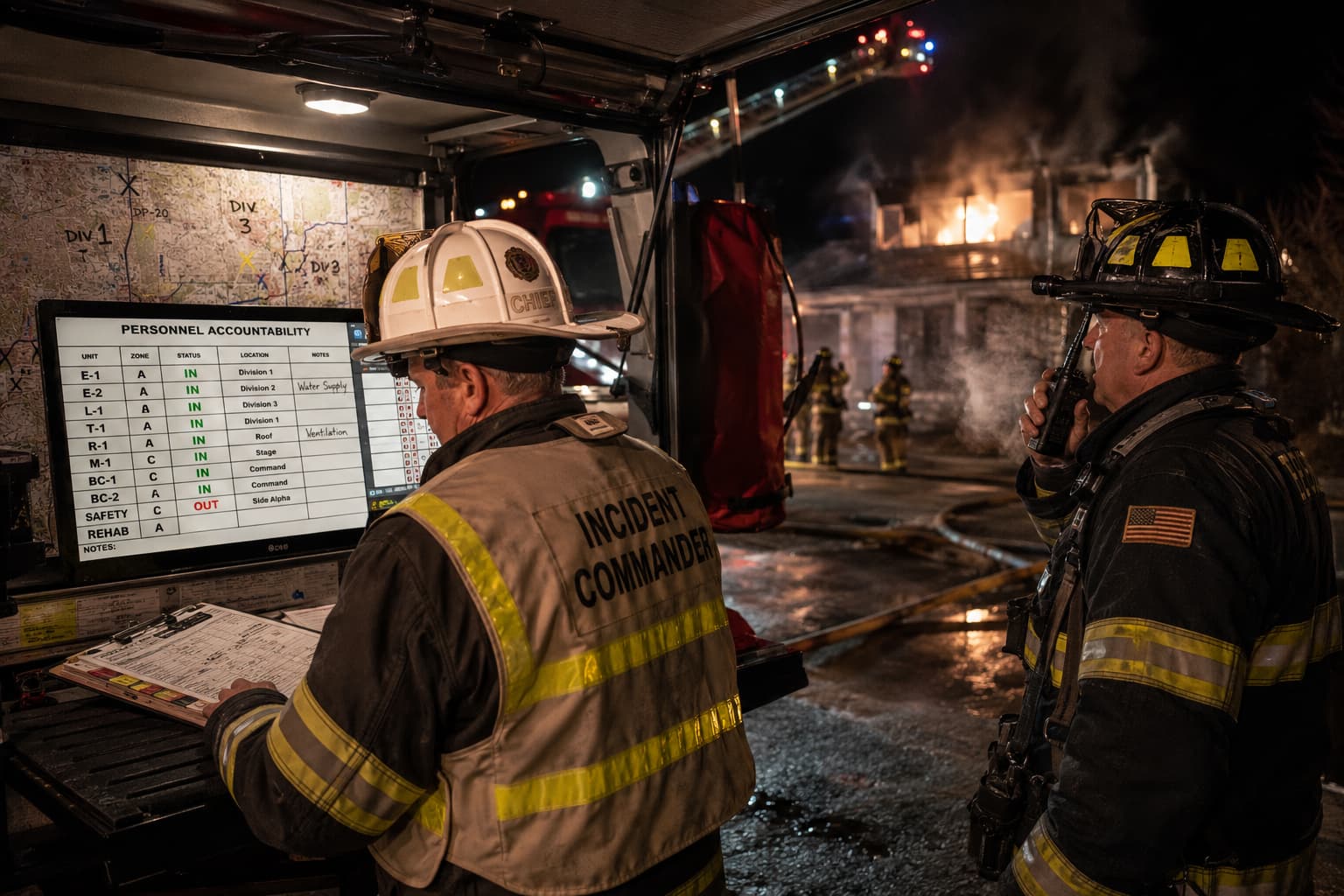
Technology at the command post earns its place only when it improves situational awareness, accountability, communication or decision-making without adding unnecessary workload. Incident command technology should help the IC recognize what matters, not require the IC to become another system operator.
Manual accountability systems can work extremely well, but complexity increases quickly as additional alarms, mutual-aid companies, divisions, groups, tactical channels and relief crews are added.
Preplans may exist as PDFs, binders or separate databases that are difficult to locate, outdated, or too complicated to use quickly during an incident.
Important information may exist in CAD, accountability, UAS video, thermal imaging, building systems, maps, radio traffic and individual officers' observations. The IC still has to assemble much of that information mentally.
Benchmarks, air status, radio traffic, assignments, changing conditions, safety issues and tactical objectives compete for limited attention. Technology has value when it identifies meaningful exceptions instead of adding another stream of data.
Systems that analyze radio traffic, unit status, sensor information, location, benchmarks or other incident data and attempt to identify important changes that deserve the incident commander's attention.
Why it matters
The near-term opportunity is not an autonomous incident commander. It is a second set of eyes that may help a human recognize something important under high cognitive workload. The risk is false confidence, missed events, unnecessary alerts, and automation bias. Ask what exact decision the system is supporting, what information it monitors, how often it is wrong, and what its false positives and false negatives look like. Ask whether the IC can understand why an alert occurred, what happens when the data is incomplete, and who remains responsible for the decision.
Structural models of high-risk buildings that a crew can navigate before arrival, fed by inspection and construction data.
Why it matters
The capture cost is the whole problem. If a twin can be generated from data you already collect on inspection, it becomes viable. If it needs a bespoke survey per building, it will not scale past a showcase. Treat any claim of live fireground use as experimental until you have seen it work on a real incident.
Not what demonstrated well. What did the IC actually use, and what did the aides use? How much information had to be entered by hand while the incident was running? What happened when connectivity degraded? Did mutual-aid companies fit into the system, or did they end up outside it? What manual backup did you keep? And knowing what you know now, would you deploy it again?
Government, standards and peer-reviewed sources on this problem. Every address here was checked before it was published.
NIST's public-safety challenge for incident command dashboards, including the evaluation phases and the winning entries.
Why it matters
NIST evaluated these systems on usability, handling multiple data feeds and reducing the technical burden on the IC. That is the right test, and it is rarely the one a demonstration applies.
What information responders actually need during a building incident, and how it should be presented.
Why it matters
A defensible answer to what belongs on the screen, from outside the vendor that wants to sell you the screen.
NIOSH's consolidated recommendations drawn from its firefighter fatality investigations.
Why it matters
Incident command, communications and situational awareness appear repeatedly in these recommendations. That is the case for getting command technology right, and it is not a marketing claim.
The national framework for command, resource management and coordination.
Why it matters
Any command system you buy has to fit the structure your mutual-aid partners are already using.
A digital twin of a firefighter training tower, used for monitoring during training scenarios.
Why it matters
A concrete look at what a working digital twin currently involves. This is a research platform on a training tower, not a proven fireground deployment.
A digital twin system for monitoring evacuation during a building fire.
Why it matters
Shows the direction of the research. Laboratory and modelled conditions, not an incident.
A review of where digital twin work for building evacuation currently stands.
Why it matters
The best single starting point, because it surveys the field rather than advocating one system. Note throughout that this remains research.
Related guide on the Hub.
Related guide on the Hub.
Related guide on the Hub.
Related guide on the Hub.
Nothing here is paid placement. Links are chosen because they are the clearest explanation we could find, and labeled so you know who wrote them.