
Step 1 · Start With the Problem

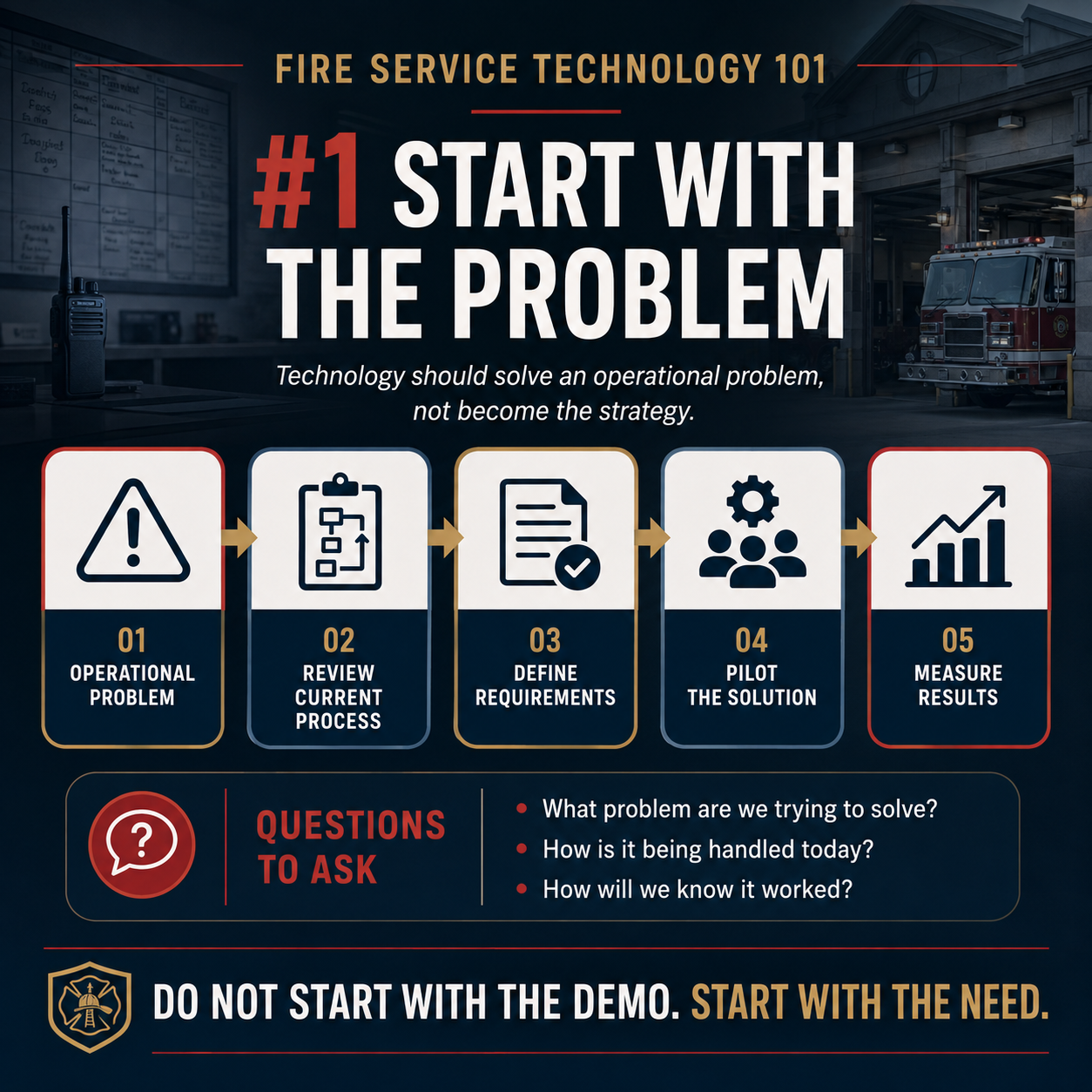
Do not start with a product demonstration. Clearly define the operational problem, inefficiency, risk or opportunity before discussing technology.

GUIDE · 12 min read
Step 1 · Start With the Problem

The short version

The first technology decision is deciding whether technology is actually the answer. Start by describing what is happening today, who it affects, how often it occurs, and what operational consequence it creates. There is a real difference between “we are losing too much time checking and locating equipment, expiration dates are occasionally missed, and we do not have a reliable department-wide view of inventory” and “we need an inventory tracking system.” The first describes your operation and leaves every option open. The second has already chosen the answer, and it is the sentence most departments walk into a demonstration carrying.

Describe the condition, not the cure

There is a real difference between these two sentences, and almost every technology decision a department gets wrong can be traced back to starting from the second one.

DESCRIBES A CONDITION
We are losing too much time checking and locating equipment, expiration dates are occasionally missed, and we do not have a reliable department-wide view of inventory.
ALREADY CHOSEN THE ANSWER
We need an inventory tracking system.

The first statement describes an operational condition. The second statement has already selected a solution.

A well-written problem statement should leave multiple possible solutions open.

Rule #1: If you cannot describe today's condition, you have not defined the problem yet

A problem statement needs more than a story. Before evaluating technology, establish a baseline that describes what is happening today. The baseline does not have to be perfect, but it needs to be measurable enough that you can return to it later and determine whether anything improved.

WEAK
SCBA checks take too long.
BETTER
SCBA checks average 22 minutes per apparatus at shift change, measured over two weeks.

The exact measure will be different for every problem. It may be time, errors, missed inspections, duplicate entry, response performance, overtime, expired equipment, user complaints, unavailable units, documentation delays, or another operational measure.

Do not create fake precision. If the number genuinely is not available, qualitative evidence is acceptable — but say plainly that it is qualitative, so nobody later mistakes an impression for a measurement.

If you do not establish the baseline in Step 1, Step 11 has nothing meaningful to measure against.

Your baseline should answer

  • What are we measuring?
  • What is the current number or condition?
  • Where did the information come from?
  • Over what period was it measured?
  • Is the information reliable enough to use as a starting point?

Identify three people before you move forward

These may be three different people, or three different groups. They are rarely the same person, and treating them as though they are is one of the most reliable ways to lose a project at the second budget hearing.

1. Who feels the problem?

The person or group dealing with the problem during the actual workflow.

  • Firefighter
  • Company officer
  • Dispatcher
  • Paramedic
  • Inspector
  • Logistics employee

2. Who owns the money?

The person responsible for the budget, purchasing decision, or funding source.

  • Division chief
  • Fire chief
  • City purchasing
  • Finance
  • Grant manager

3. Who has to change their behavior?

The people whose daily workflow will change if the project succeeds.

Technology projects often fail when these groups are treated as though they are the same stakeholder.

The person who wants the technology is not necessarily the person who has to live with it.

Did the problem exist before the demo?

One of the most common technology-adoption mistakes is seeing a product first and writing the problem statement afterward to justify buying it.

Discovering technology at FDIC, FRI, Technology Summit International, a vendor demonstration, a conference exhibit hall, or a peer department is genuinely useful. That is how most of us learn what is possible, and there is nothing wrong with it.

The problem occurs when a department moves directly from “that is impressive” to “we need one” without stopping in between to write down what it would actually be solving.

A useful test: if your problem statement has only one possible solution, you may have written it backward from the product.

A good problem statement should leave at least three reasonable approaches open.

Those approaches might include

  • Buy a commercial system
  • Use a capability already owned
  • Build a limited internal tool
  • Integrate existing systems
  • Change the workflow
  • Change policy or an SOG
  • Train differently
  • Buy nothing

Sometimes the right technology decision is not to buy technology.

Before buying anything, find out what you already own

Departments regularly discover that part or all of the capability they are looking for already exists inside a system they own. It may never have been configured, integrated, licensed, documented, or taught to the people who need it.

This is not an optional extra step. Treat it as a precondition of finishing Step 1 — the related guide “Map the Systems You Already Have” is where to do that work.

Before moving to Step 2, ask

  • What systems already touch this workflow?
  • What data already exists?
  • What integrations already exist?
  • What features are already included in our licenses?
  • What features require configuration rather than another purchase?
  • Is someone already solving part of this problem manually?
  • Did we buy something previously that was never fully implemented?
  • What contracts or systems would a new solution have to connect with?

Do not buy the second system until you understand the first one.

Write it in operational language

Today, [WHO] experiences [CURRENT CONDITION], resulting in [OPERATIONAL CONSEQUENCE]. Our current baseline is [MEASURE]. We want to improve that to [TARGET] without assuming a specific technology is the answer.

EXAMPLE ONLY — NOT A BENCHMARK
Today, station crews spend an average of 22 minutes per apparatus at shift change verifying equipment, and expired or missing items are still occasionally discovered later. We want to reduce verification time while improving equipment accountability without assuming an inventory software purchase is the only solution.

The 22 minutes above is an illustration of the format, not a figure from any real department and not a benchmark to measure yourself against. Your number comes from your own two weeks of watching.

What would better actually look like?

Do not end Step 1 with “fix the problem.” Define the condition you want to create.

  • Reduce average inspection time
  • Reduce missing equipment
  • Reduce duplicate documentation
  • Improve data completeness
  • Reduce unnecessary radio traffic
  • Improve hospital handoff time
  • Improve turnout reliability
  • Reduce administrative workload

The target becomes the bridge between Step 1 and Step 11.

You are ready for Step 2 when…

  • The problem is written without naming a product.
  • A baseline exists.
  • The people who feel the problem have been identified.
  • The budget owner has been identified.
  • The people whose behavior must change have been identified.
  • Existing systems and capabilities have been checked.
  • More than one possible approach remains open.
  • A target condition has been defined.

Fire Tech 101 · Step 1 Problem Definition Worksheet

Fill this in before moving to Step 2. If a box cannot be filled, that is the part of the problem still undefined.

Download / Print the Step 1 Worksheet

See it applied

Start here

If you read one thing on this subject, read this.

Hub guidePublic Safety Technology Hub

Related guide · Map the Systems You Already Have

Where to do the work of finding out what you already own.

Why it matters

Step 1 is not finished until this has been done. Half the time the capability is already sitting unused in a system nobody was trained on.

Go deeper

Questions to answer before you shop

  1. What exactly is happening today?
  2. Who feels the problem during the actual workflow?
  3. Who owns the budget or funding decision?
  4. Who will have to change their behavior?
  5. What is our current measurable baseline?
  6. Where did that baseline come from?
  7. What is the operational consequence if nothing changes?
  8. Is this primarily a technology, process, policy, training, staffing, or leadership problem — or some combination?
  9. What systems or capabilities do we already own that touch this problem?
  10. Was this problem defined before anyone saw a specific product?
  11. What are at least three possible approaches?
  12. What would better look like?
  13. What target will we use later to decide whether the change worked?