
Step 7 · Evaluate Total Cost of Ownership

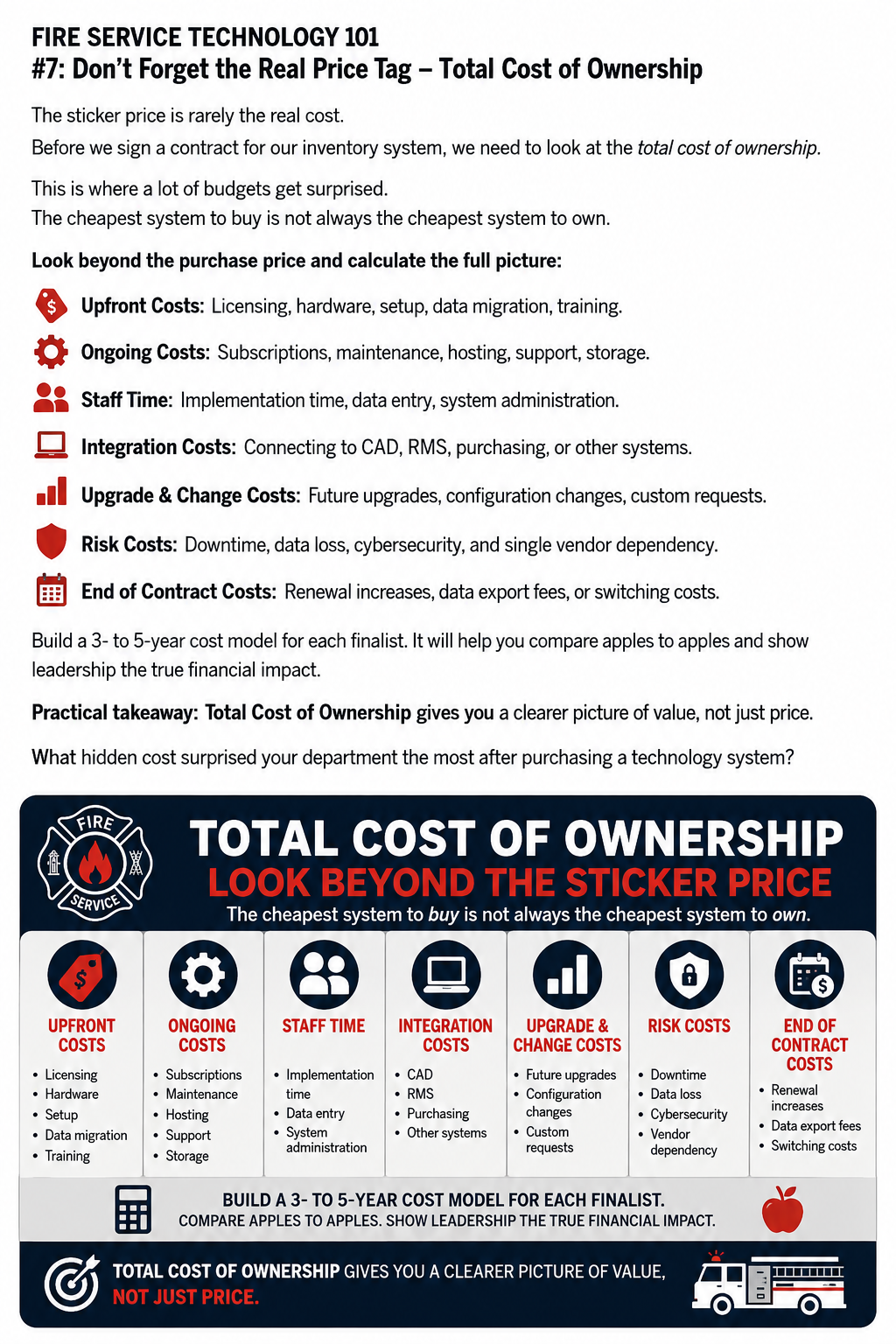
The purchase price is only part of the cost. Account for implementation, hardware, integrations, licensing, training, support, replacement, connectivity, staff time, upgrades and eventual migration.

GUIDE · 15 min read
Step 7 · Evaluate Total Cost of Ownership

The short version

The number on the quote is rarely the number you will live with. For an inventory system the tags, scanners and mounting hardware can outweigh the software, and the staff hours to build the initial inventory are real money whether or not anyone writes them down. Cost the whole life of the thing: initial purchase, implementation, hardware, integration, annual licensing, connectivity, training, staff time, support, upgrades, replacement, data migration, contract escalation and what it costs to leave.

The five-year number matters more than the first-year number

Most technology purchases are approved on the first-year number, because that is the number on the quote and the number the budget cycle asks for. It is also the smallest number the project will ever produce.

A five-year view changes decisions. It exposes the subscription that steps up in year three, the tags that have to be replaced in year four, the integration that carries its own annual fee, and the staff time that was never costed because it was absorbed by people already on the payroll.

Build the number in five parts. Acquisition and implementation happen once. Training happens more than once. Operations happen every year. Lifecycle costs arrive late, which is exactly why they get missed.

Acquisition

What it costs to get the thing. This is usually the only part on the quote.

  • Software
  • Hardware
  • Devices
  • Tags and sensors
  • Installation
  • Initial licenses

Implementation

What it costs to make it work in your department. Some of this is invoiced by the vendor. Some of it is your own people, and it is real money whether or not anyone writes it down.

  • Configuration
  • Data migration
  • Integration
  • Consulting
  • Project management
  • Staff time
  • Testing

Training

Training is not a single event. It happens at go-live, again when the system changes, and again for every person hired afterward. In a department that runs shifts, the cost of training is often the cost of covering the shift.

  • Initial training
  • Overtime
  • Backfill
  • Instructor costs
  • Retraining
  • New-employee training

Ongoing operations

What it costs every year to keep the system running. This is the number that has to survive a budget cycle, and the number most often missing from the original request.

  • Annual subscriptions
  • Licensing
  • Connectivity
  • Hosting
  • Maintenance
  • Support
  • Device management
  • Staff administration
  • Replacement equipment

Lifecycle

What arrives after the first budget cycle and before the last one. These costs are predictable, they are rarely in the original request, and they tend to land in a year when nobody has planned for them.

  • Price escalation
  • Hardware replacement
  • Battery and sensor replacement
  • Integration maintenance
  • Major upgrades
  • Data migration
  • End-of-life replacement
  • Exit costs

Add all five together before the decision, not after it. The five-year total is the number a governing body should be approving.

Grant-funded does not mean free

Grant funding is one of the most useful tools a fire department has. It is also the most common way a department ends up owning something it cannot afford to keep.

A grant can solve the acquisition problem without solving the sustainment problem.

Grant awards are generally built to buy things. The costs that follow are usually the department's to carry, and they begin the day the grant period ends.

If the department cannot identify the operating line that pays for the technology after grant funding ends, the project is not financially sustainable yet.

That is not an argument against applying. It is an argument for answering the sustainment question during the application, while there is still time to build the line into a future budget request and while the size of the request can still be adjusted to something the department can carry.

What the department is likely to carry after the grant

Work through this list before the application, not after the award.

  • Annual software subscriptions
  • Cloud fees
  • Connectivity
  • Hardware replacement
  • Device replacement
  • Support
  • Training
  • Integration maintenance
  • Staff administration
  • Contract escalation

Ask who pays on Day 366.

Grant rules are not all the same

Grant programs differ. Requirements vary by program, by award year, by funding source and by what is being purchased, and federal requirements sit alongside your state law, local ordinance and your own procurement policy rather than replacing them.

Do not assume that what was allowed under one award is allowed under another. For any grant-funded purchase, follow the requirements applicable to that specific grant, applicable state and local law, and your department's own procurement policies. Involve your purchasing and grant administration staff early enough that the answer can still change the plan.

FEMA's guidance for recipients and subrecipients is explicit on one point worth remembering: where federal, state, tribal and local procurement rules differ, follow the most restrictive rule.

Vendor viability is part of total cost

A technically strong product can still create long-term risk if the company, ownership structure, support model, or pricing changes substantially.

This is not about guessing whether a company will survive. Your department is not in a position to assess anyone's balance sheet and should not try. What you can do is ask what your position would be under each of the changes that routinely occur in this market — an acquisition, a change of ownership, a discontinued product, a support model that moves, a price that resets at renewal — and get those answers into the contract rather than leaving them in a meeting.

Questions that surface vendor risk

  • How long has this product been operating?
  • How many public-safety agencies use it?
  • What happens if the company is acquired?
  • Can the contract be assigned to a new owner without our approval?
  • What happens if the product is discontinued?
  • How much notice is provided before end of support?
  • What happens to our data if the company closes?
  • Are annual increases capped?
  • Can critical integrations survive a vendor change?
  • Is there a practical migration path?

None of these questions predict a company's future. They establish what your department's position would be if the future changes, which is the part you can actually control at contract time.

This is a risk-management framework, not a vendor-rating system. The Hub does not score companies on financial health, and a solicitation should not either. Treat the answers as terms to negotiate, not as a grade.

Cost the person who owns the system

Someone will administer this system after implementation. That work has a cost even when it is absorbed by existing staff.

Absorbed cost is still cost. It shows up as a company officer doing user administration at the kitchen table, or an administrative assistant learning a reporting tool nobody budgeted to train them on. It is invisible in the business case and completely visible in that person's week.

What administering a system actually involves

  • User administration
  • Password and access issues
  • Configuration
  • New employee setup
  • Reports
  • Vendor support tickets
  • Data maintenance
  • Training
  • Integration monitoring
  • Renewals
  • Updates
  • Documentation

If the entire system depends on one technically interested employee doing invisible work, that is a cost and a continuity risk.

Estimate the hours before you buy. Even a rough figure — two hours a week, a day a month — turns an invisible cost into something a budget can hold and a supervisor can plan around.

It also makes the argument for a named backup administrator while that is still a planning decision rather than an emergency. Step 8 covers who those people are and what has to be written down before go-live.

See it applied

Go deeper

Official resourceFEMA

Assistance to Firefighters Grants Program

The program page for AFG, SAFER and Fire Prevention & Safety, with the current guidance documents and application periods for each.

Why it matters

Read the guidance for the specific grant and award year you are applying under. Requirements differ between programs and change between years, and the guidance is where the sustainment expectations are set out.

Official resourceFEMA

Purchasing Under a FEMA Award: Complying with the Federal Procurement Standards

FEMA's Procurement Under Grants guidance, including which rules apply to which type of entity, the documentation expected at each stage, and links to the current Procurement Under Grants Policy Guide.

Why it matters

If any part of the purchase is grant-funded, this is the standard your file will be measured against. It states plainly that where federal, state, tribal and local rules differ, the most restrictive rule applies.

Official resourceU.S. Fire Administration

Fire Service Grants and Funding

The USFA's index of federal grants for fire and EMS, plus its guide to funding alternatives when a grant is not the right answer.

Why it matters

Useful at the point where you have established that the department cannot sustain a purchase on grant funding alone and need to know what other funding routes exist.

Questions to answer before you approve the cost

  1. What is the total five-year cost?
  2. What costs appear after the first year?
  3. What staff time will administration require?
  4. What hardware must be replaced, and when?
  5. What integrations carry recurring costs?
  6. What annual escalation is allowed?
  7. What does training cost, including overtime and backfill?
  8. If grant-funded, what budget line pays on Day 366?
  9. What happens if the vendor is acquired or the product is discontinued?
  10. What does it cost to retrieve and migrate our data?
  11. What does it cost to leave?