
What CAD Actually Does — and What It Doesn't
How a 911 call becomes an incident, how units are recommended and dispatched, how apparatus status and location are tracked, and why so many other department systems depend on CAD.
Read
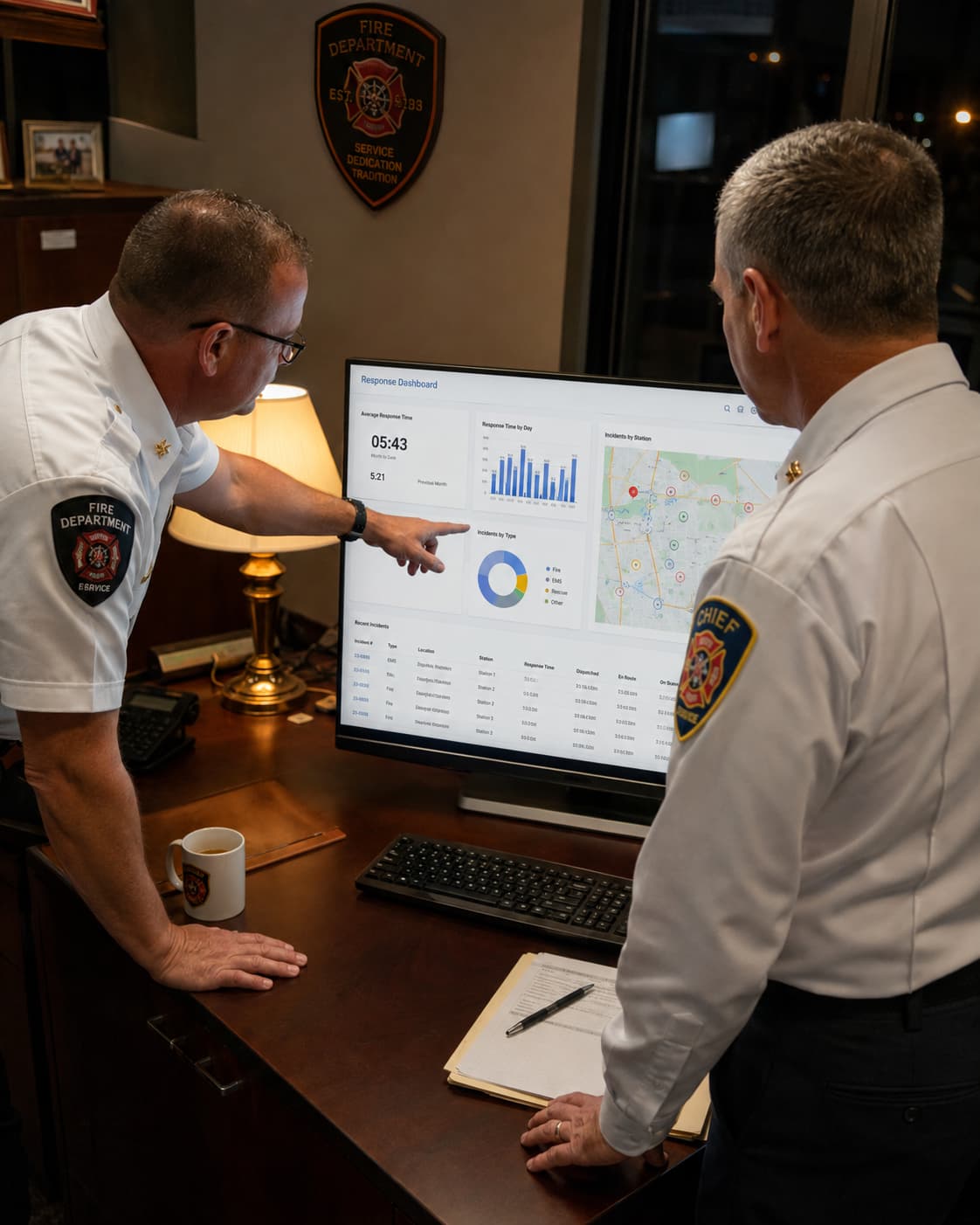
Fire and EMS agencies already collect enormous amounts of information. The challenge is getting trustworthy data out of disconnected systems, turning it into information people can actually use, and applying automation or AI only where it improves a defined problem. The same is true of the systems that run the organization rather than the incident. Inventory, scheduling, budgeting and planning are where most of a department's administrative time goes, and where most of its data is created in the first place. They belong here for that reason: none of them is a separate technology problem, and all of them fail the same way, by producing numbers nobody can defend.
Incident and patient-care documentation competes with operational readiness and other responsibilities. Repetitive entry, poorly designed workflows and disconnected systems increase workload while inconsistent documentation reduces the value of the information later.
Years of CAD, RMS, ePCR, staffing and response data may exist while deployment and operational decisions are still made primarily from anecdote.
CAD knows one part of the incident. RMS knows another. ePCR contains patient care. GIS knows location. Staffing systems know who was available. Useful analysis often requires connecting information that was never designed to work together.
Time goes on locating equipment before it is needed, service and expiration dates are found late or found by an inspector, and nobody can answer a straightforward question about what the department owns.
Filling a shift takes an officer off other work, callback order is argued about after the fact, and the department cannot say what overtime is actually being spent on until the year is over.
A request built on last year's request is argued on opinion, and a governing body that cannot see the basis for a number treats every number in the submission the same way.
Station location, staffing and apparatus decisions are made one at a time as each becomes urgent, and each one is argued from scratch.
How a 911 call becomes an incident, how units are recommended and dispatched, how apparatus status and location are tracked, and why so many other department systems depend on CAD.
What fire department records systems do, how incident data moves from CAD into reporting systems, what changed with the transition from NFIRS to NERIS, and why fire departments should understand their data even when a vendor submits it for them.
What the first hours look like when CAD, records or email are gone, who decides what comes back first, and how a department keeps answering calls while it happens.
Learn how to read response-time distributions, workload, unit utilisation, concurrency, incident types and other operational measures without being misled by a single average.
A dashboard should help someone make a decision. Start with the question and the audience rather than filling a screen with every field available in the database.
Artificial intelligence is useful for some tasks and unreliable for others. Learn where current tools can save time, identify patterns, summarise information and assist people — and where confident output should not be trusted.
Establish the rules before widespread adoption. Define acceptable uses, sensitive information, human responsibility, records requirements, procurement expectations, and what must happen when AI is wrong.
Systems that analyze radio traffic, unit status, sensor information, location, benchmarks or other incident data and attempt to identify important changes that deserve the incident commander's attention.
Why it matters
The near-term opportunity is not an autonomous incident commander. It is a second set of eyes that may help a human recognize something important under high cognitive workload. The risk is false confidence, missed events, unnecessary alerts, and automation bias. Ask what exact decision the system is supporting, what information it monitors, how often it is wrong, and what its false positives and false negatives look like. Ask whether the IC can understand why an alert occurred, what happens when the data is incomplete, and who remains responsible for the decision.
Running ESO for EMS records and looking at First Due for fire. Both vendors say it is supported. Looking for someone who has actually run it in production.
Vendor says we are ready. Our data says otherwise. Curious whether anyone has completed a clean migration and what they had to fix first.
Government, standards and peer-reviewed sources on this problem. Every address here was checked before it was published.
A voluntary framework for identifying and managing the risks of an AI system.
Why it matters
A neutral structure for the questions to ask a vendor selling AI, and the basis of a defensible department policy.
The companion profile covering risks specific to generative AI.
Why it matters
Directly relevant to assisted report writing. Confabulation is a named risk here, which is why a generated narrative is reviewed before anyone signs it.
National EMS data reported publicly.
Why it matters
A reference point for what your own numbers look like against the national picture.
Related guide on the Hub.
Related guide on the Hub.
Related guide on the Hub.
Related guide on the Hub.
Nothing here is paid placement. Links are chosen because they are the clearest explanation we could find, and labeled so you know who wrote them.